Saturday, August 11, 2012

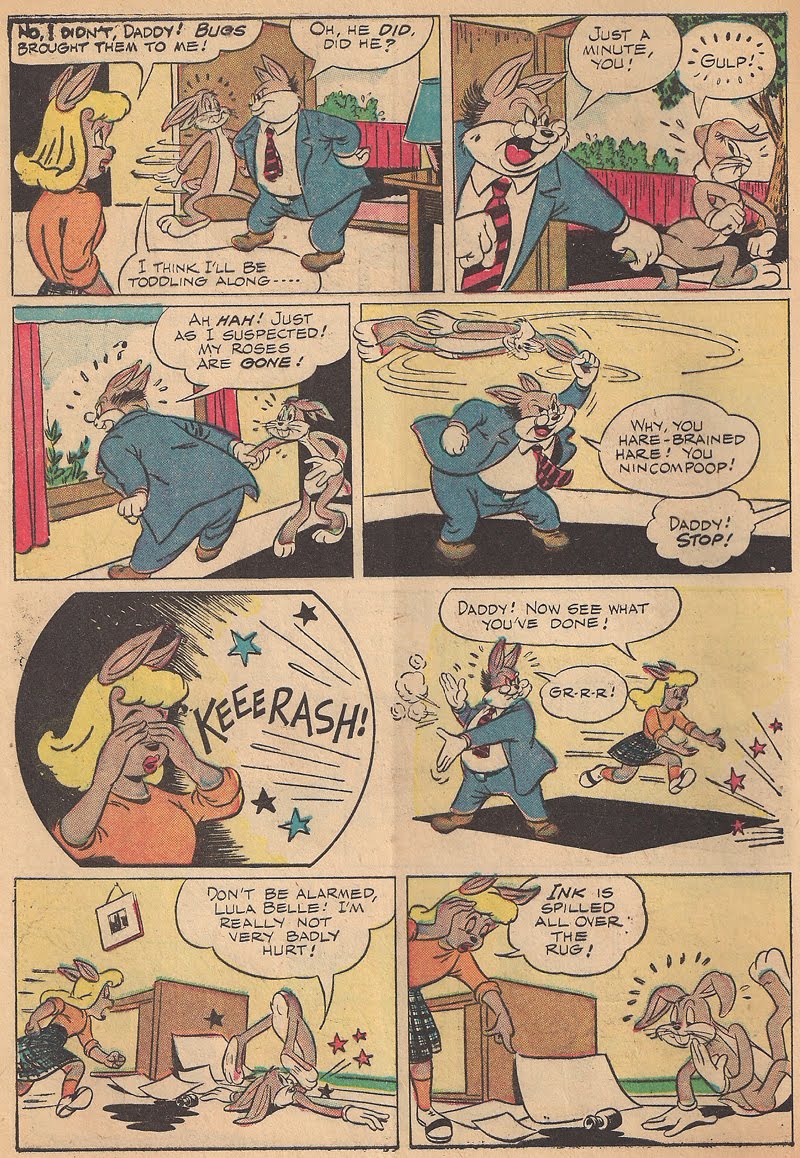
"Looney Tunes and Merrie Melodies"(Dell) # 73, November 1947: "Bugs and the Rug"

Regarding the previous post of the 1981 Bugs Bunny story, to quote comedian Larry the Cable Guy: "Lord, I apologize fer that right thar." But compare that 1981 story with this gem from 1947. This one has GOOD art, good characterization, excellent staging, and clever writing.

Bugs tries to impress his girlfriend, Lula Belle, but ends up making her father hopping mad. Bugs picks his roses and stains his rug with ink. Lula Belle suggests that Bugs find a job so her dad will respect him. Bugs takes Porky Pig's suggestion of starting his own business, and decides to start with inventing a stain removing formula, and tests it on the ink-stained rug.

Then the inevitable twist comes into play.

It's fun to see Bugs Bunny interpreted as a well-meaning loser, and his chemistry with Lula Belle, Lula Belle's dad, and Porky are interesting. As for Lula Belle, she appeared several times in the mid to late 1940's comics, but never in the cartoons. She was eventually replaced by Honey Bunny, who also never appeared in animated form. I'll get to Honey Bunny at a later date. The only love interests for Bugs to appear in animated form were Daisy Lou in "Hare Splitter" (1948) and Lola in "Space Jam" (1996) and other modern Looney Tunes incarnations. Other interests were either robotic or undesirable.

The writer of this story is unknown. The artist was most likely Tom or Charles McKimson.

*Update: Possible artist identified: Roger Armstrong.


"Bugs Bunny" (Whitman)#233, 1981: "Food Feud"

This story from 1981 isn't near as bad as it looks. Oh, it's far from inspired writing, and the artwork leaves a lot to be desired (okay, the artwork bites a big one, and I don't mean carrot.) I have to question who drew this, because whoever it was, the concept of facial expression eluded him. Every character, in just about every panel, has their mouth open. Maybe they just didn't care. Maybe somebody rolled joints with the character model sheets long before this was drawn, and the artist just winged it.

But it actually does manage to get the personalities of Bugs and Daffy right, and they interact the way they did in some of their cartoon matchups. It's also amusing to see Bugs Bunny address an actual doctor as "Doc".


Friday, August 10, 2012

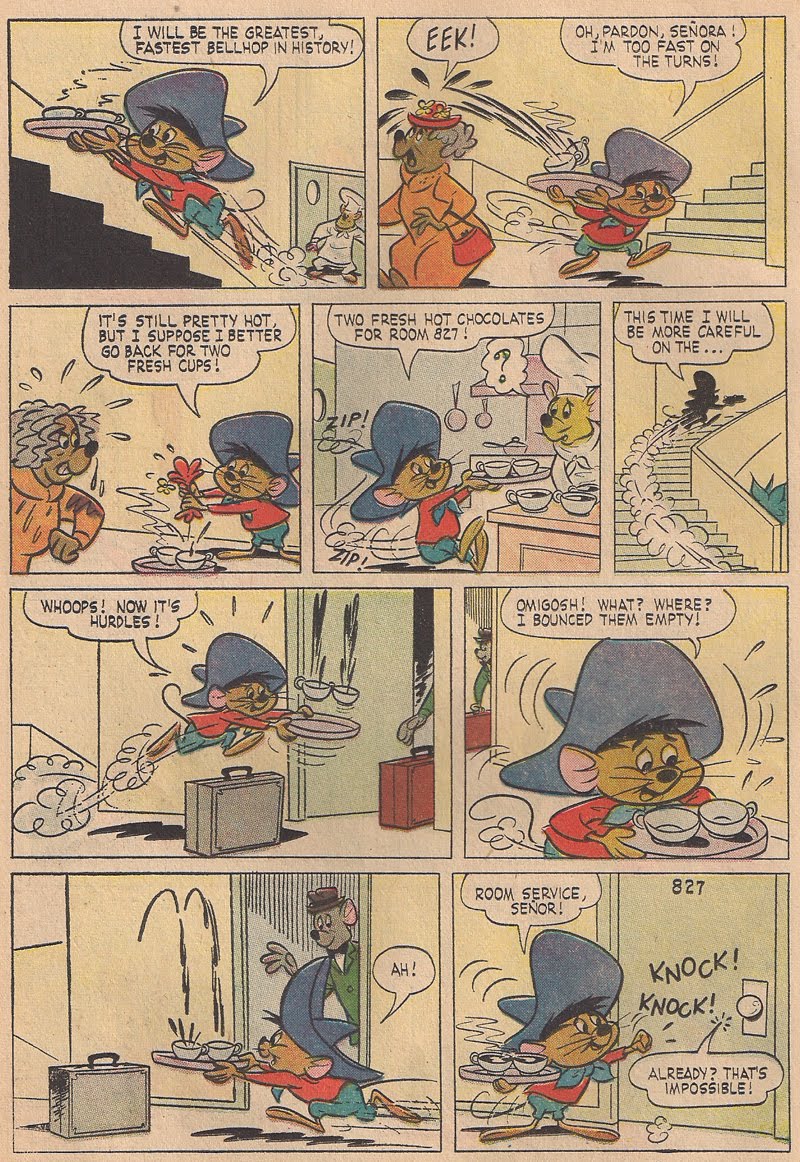
"Looney Tunes" (Dell) # 244, February/March 1962: "Bellboy Bust"

If you know anything about my love of Warner Bros. cartoons, you know that I enjoy the Speedy Gonzales cartoons. Many years ago, the Cartoon Network (then under the reign of Ted Turner) got a political correctness bug up their butt and decided to snap up the broadcast rights to every classic Warner short ever made, and then cease to air any one of them that they deemed offensive. Speedy's cartoons got the axe entirely. I raised a stink about it, wrote them an email, and it resulted in me getting a bunch of fans together to sign a petition. It could have easily fizzled after that, but the thing took on a life of its own. A Hispanic activist group caught wind of it and not only agreed with my argument that the Fastest Mouse in all Mexico was not racist, but a positive role model for Latinos. It made national news. Newspaper comic strip artists weighed in on it. Rush Limbaugh even said something. In the end, Cartoon Network couldn't argue with over 2,000 signatures and a flood of bad press calling their censorship moronic.

Such is the nature of Speedy's popularity. It turned out he was just as popular in 2000 as he was in 1960. Even the man who directed most of Speedy's best shorts, Friz Freleng, couldn't figure out why Speedy was so popular THEN. I think the reason is that he's a likeable, unique character. He's not particularly deep or complicated. He IS a Mexican stereotype, but he's not negative or mean-spirited, just sort of a mouse superhero who happens to be Mexican and speak fractured Spanish. If Robert McKimson and Friz Freleng were trying to offend Mexicans, it backfired...because the Mexican community found it funnier than they did.

Anyway, Speedy also appeared in comic book form a few times in his heyday, including his own one-shot self-titled issue in 1960. The story below comes from a 1962 issue of the Dell "Looney Tunes" title, and explores a concept that could have been a great cartoon: Speedy taking a job as a hotel bellboy and failing miserably at it because he's TOO fast. Perhaps Friz Freleng, who thought the Speedy character was too one-dimensional, should have tried this twist: let him fail once in a while.

Incidentally, we all know about Speedy's cousin, Slowpoke Rodriguez. Here, we learn that he has another cousin named "Spoofy".

I've also included two one-page "topper" gags from the same issue, in which Speedy has some fun with a cat (not Sylvester.)

*Update: Art by Pete Alvarado.


Thursday, August 9, 2012

A Word From the Author

I started this blog in hopes that someone out there will wake up and put some serious effort into collecting, preserving and anthologizing this material. Anthologies of classic comics are more popular than ever now, and “funny” comic books are making a comeback. So much love and devotion has been put into preserving and glorifying classic superhero comics, and it seems like that stuff is all comic book fans have talked about for decades.


Not so anymore. There is an explosion of great books collecting the Disney comic strips and books. There’s a series of collections featuring Popeye, Barney Bear, Richie Rich, Casper the Ghost, Baby Huey and dozens of others. So why can’t someone get their ass in gear and do some collections of Looney Tunes comics?

NOW is the time.

A few people have recently called me a pirate, and accused me of somehow depriving the artists of royalty profits. Actually, my intent is exactly the opposite. I bought the comics (Or in some cases, they were given to me) and decided to post selected stories from them that I liked. I’m no more of a “pirate” than people who resell these comics in comic shops and online for 3 times what they were originally worth. If there were any officially licensed way to see this stuff, it would be different.

As for royalty profits, most of the artists who worked on the classic Western Publishing stories are dead, and probably had no royalty deal in the first place. They got paid peanuts to do what they did, and I actually want to give them something far more valuable than any money they SHOULD have gotten: a legacy. Warner Bros., this is your wake-up call. There are literally THOUSANDS of comic book stories featuring the universally beloved and revered Looney Tunes characters, many of them written and drawn by the brilliant artists who helped create the classic cartoons themselves. The characters have had a life in print for over 70 years, and for about 50 of those years, the artists responsible went uncredited. It was a crime then and it’s a crime today, one that will remain unsolved until a serious effort is put into finding, restoring and re-releasing their work.

As I write this, there are STILL Looney Tunes comics being released under the D.C. banner, and while largely reprints from the 90's these days, new stories are being made, and the artists, thankfully, are credited. But these works of art, too, are largely unsung. They’re not promoted, the comic book stores don’t have posters and statues and newsletters recognizing their existence. But they’re out there. As a cartoonist myself, I know how hard it is to get ones work noticed, and I know that when someone shares my own work with others, it gives me far more gratification than any money I could get for it.

For many years, I have collected these comics. I buy the new ones, and I’ve bought all the old ones I’ve been able to afford.

I know there are people out there who have larger collections, and know infinitely more about this material. These are the people I want to reach, and the people I want to comment on this blog. Many of them already have. We need to convince the powers that be to preserve and save these wonderful comics, before the acres of musty, yellowed newsprint they were printed on turns to dust and fades into the ether forever…and an entire chapter in the history of Bugs Bunny, Daffy Duck, Porky Pig, Sylvester, Tweety, Road Runner, and others fades from history.

Until that happens, I’ve got the internet, 2 boxes of classic comics, and a scanner.

Enjoy.

-Matthew Hunter

"Looney Tunes and Merrie Melodies" (Dell) #14, December 1942 "Sniffles and Merrie Jane"

Here's an early Mary Jane and Sniffles story with a twist: they interact in their miniature form with Bugs, Porky and Elmer! To make it even more bizarre, their shadows separate from them and run off playing pranks on Bugs and co...and none of them question the absurdity of it.

*Update: Art by Roger Armstrong.


Saturday, August 4, 2012

"Looney Tunes" (DC) #45, October 1998: "Wise Quacker"

In this 1998 story by David Weiss and David Alvarez, homeless Daffy Duck sees a sign for a comedy contest at a nightclub. As luck would have it, the audience is made up entirely of rabbits, and they don't find his schtick funny at all!


Thursday, August 2, 2012

"Looney Tunes" (Dell) #243, January 1962: "Beep Beep Run"

Here's a nicely drawn short story with Wile E. Coyote, "Beep Beep" the Road Runner and the Road Runner's 3 rhyming kids. Art and story (most likely) by Phil DeLara and Mike Maltese.


*Correction: I had originally credited the art on this story to Pete Alvarado. In a comment below, Mark Evanier identified the artwork as that of Phil DeLara. Thanks for the correction, Mr. Evanier. If anybody would know, it's you!